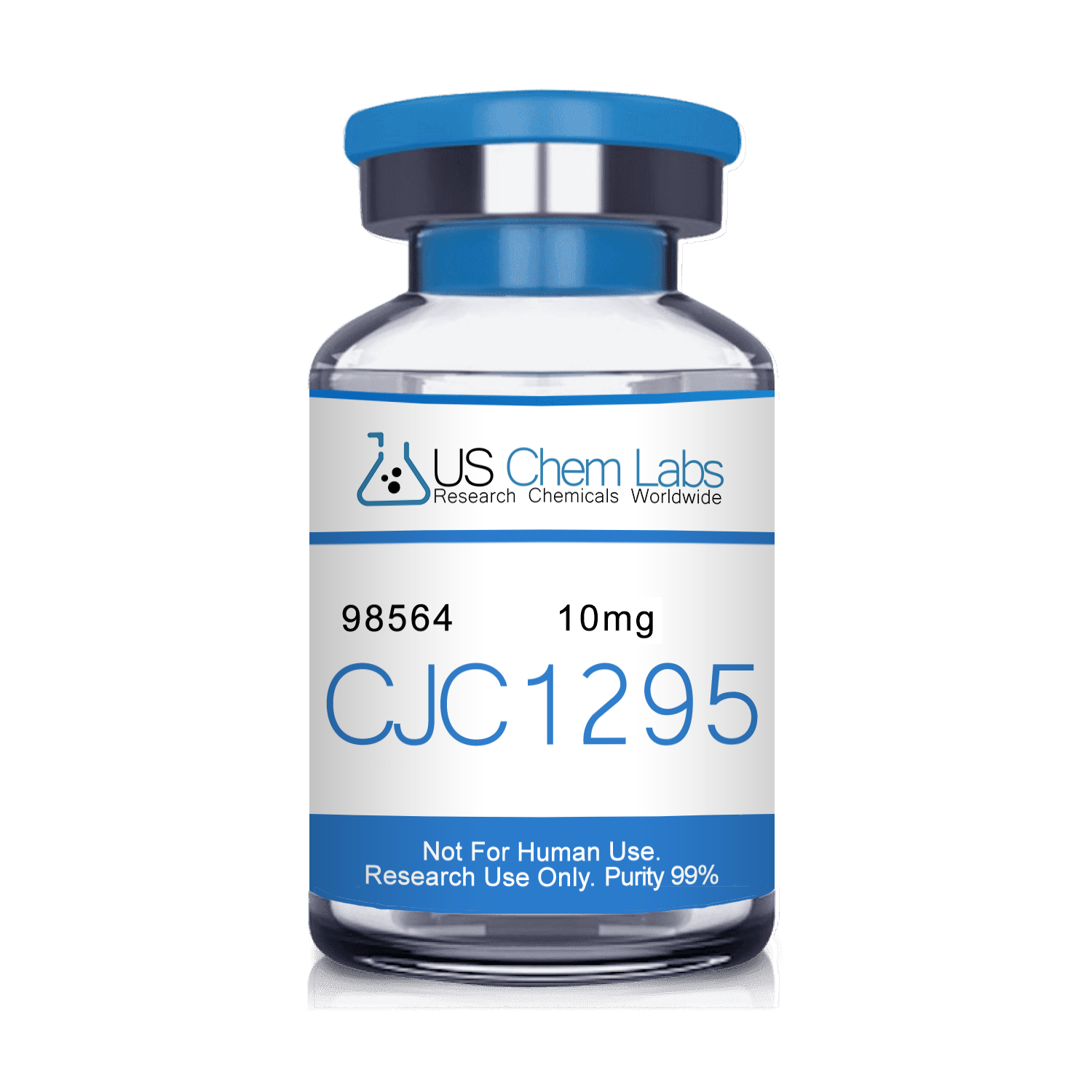
Product Usage: Our peptides are for in vitro research purposes only and are not for human consumption. The statements made within the website have not been evaluated by the USA Food and Drug Administration.
CJC-1295 No DAC in Plain English
CJC-1295 No DAC is a laboratory-made peptide made from a chain of 29 amino acids. It is commonly described as Modified GRF 1-29, a research analog related to growth hormone–releasing hormone, often shortened to GHRH. GHRH is a naturally occurring signaling peptide, while Modified GRF 1-29 was designed for laboratory research with selected amino-acid changes that make the sequence less vulnerable to rapid breakdown.
The words “No DAC” help distinguish this material from CJC-1295 with DAC. DAC stands for drug affinity complex, a modification designed to bind with albumin and change how long a peptide remains present in a biological system. CJC-1295 No DAC does not contain that modification. Because commercial names are not always used consistently, researchers should verify the exact sequence, terminal amidation, expected molecular mass, and analytical documents rather than relying on the product name alone.
Today, CJC-1295 No DAC is studied mainly as an investigational GHRH analog. Research focuses on its chemical identity, stability, receptor signaling, degradation, and behavior in laboratory models. This page explains the product’s specifications, batch documents, research background, and important identity limitations. It does not provide instructions for human or animal use.
Key Takeaways
- CJC-1295 No DAC is a synthetic 29-amino-acid GHRH analog commonly called Modified GRF 1-29.
- “No DAC” means the sequence does not contain the albumin-binding drug-affinity-complex modification.
- CJC-1295 No DAC and CJC-1295 with DAC are structurally different and should not be treated as interchangeable.
- COA, HPLC, and MS documents answer different questions about batch records, purity, and identity.
- This product is supplied for laboratory research only and is not for human or animal use.
Why Do Researchers Study CJC-1295 No DAC?
Researchers study CJC-1295 No DAC because it is a defined analog of the first 29 amino acids of GHRH. Published work involving Modified GRF 1-29 and related analogs has examined peptide stability, resistance to enzymatic breakdown, GHRH-receptor interaction, cyclic-AMP signaling, structure–activity relationships, and analytical identification.
Interest in this peptide does not establish safety or effectiveness. A major research challenge is naming ambiguity: “CJC-1295,” “CJC-1295 No DAC,” and “Modified GRF 1-29” are sometimes used as though they mean the same thing. Accurate interpretation requires matching every study and analytical document to the exact sequence and modification being evaluated.
CJC-1295 No DAC 10mg — Package Overview
CJC-1295 No DAC 10mg 5 Vials is supplied for laboratory research only. The package contains 5 vials with 10mg per vial. The total price is $343.56, or $68.71 per vial.
- Verification: current COA, HPLC, and MS documents are available on this product page.
- Purity context: ≥99% listed purity; current COA reports 99.22% purity.
- Shipping: $14.99 USPS Priority shipping is standard; see the shipping policy.
- Use boundary: research use only; not for human or animal use.
Quick Facts & Key Specifications
This section identifies the product, package configuration, catalogue metadata, and analytical-document set.
| Product | CJC-1295 No DAC 10mg 5 Vials |
|---|---|
| SKU | cjc-1295-10mg-5-vials-1 |
| Categories | CJC 1295; CJC 1295 No Dac; Peptides; Research Chemical |
| Tags | CJC; CJC 10mg; CJC 1295; GRF 1-29; growth hormone releasing factor 1-29; peptides |
| Package format | 5 vials; 10mg per vial; 50mg total; lyophilized peptide material |
| Price context | $343.56 package total; $68.71 per vial |
| Purity context | ≥99% listed purity; current COA reports 99.22% |
| Identity / sequence | Tyr-D-Ala-Asp-Ala-Ile-Phe-Thr-Gln-Ser-Tyr-Arg-Lys-Val-Leu-Ala-Gln-Leu-Ser-Ala-Arg-Lys-Leu-Leu-Gln-Asp-Ile-Met-Ser-Arg-NH₂ |
| Verification | COA, HPLC, and MS documentation displayed on this page and retained in product tabs |
| Use boundary | Laboratory research only; not for human or animal use |
Product identity, package configuration, catalogue metadata, and current analytical records.
Package5 vials • 10mg per vial50mg total package content
Price context$343.56 total$68.71 per vial
Analytical contextCOA: 99.22%COA + HPLC + MS
Molecular identity29-amino-acid analogPubChem CID 91976842
Research boundaryIn vitro research onlyNot for human or animal use
SKUcjc-1295-10mg-5-vials-1
Categories: CJC 1295 • CJC 1295 No Dac • Peptides • Research ChemicalTags: CJC • CJC 10mg • CJC 1295 • GRF 1-29 • growth hormone releasing factor 1-29 • peptidesUS Chem Labs • CJC-1295 No DAC research product documentation
What Is This Peptide?
CJC-1295 No DAC is a synthetic 29-amino-acid GHRH analog commonly described as Modified GRF 1-29. Researchers identify it by its exact amino-acid sequence, terminal amidation, molecular properties, vial format, and supporting laboratory documents.
Because it is freeze-dried, the material may appear as a fine powder, a light cake, or a compact puck inside the vial. These differences can occur during normal lyophilization. Appearance alone cannot confirm identity or purity, so the batch documents should also be reviewed. For more background, see the Peptide Storage and Handling Research Guide.
History & Research Background
Research on GHRH analogs grew from efforts to preserve receptor activity while reducing rapid enzymatic breakdown. Modified GRF 1-29 changes selected amino acids within the native GHRH(1-29) sequence to create a more stable laboratory research analog.
CJC-1295 No DAC is commonly used as a commercial name for Modified GRF 1-29. It should be distinguished from CJC-1295 with DAC, which contains an albumin-binding drug-affinity complex and has different structural and pharmacokinetic properties. Research involving the DAC-modified compound should not automatically be applied to the No-DAC sequence.
Research Snapshot: Current State of Research
Research involving Modified GRF 1-29 and related GHRH analogs focuses on receptor signaling, peptide stability, degradation, endocrine-axis models, and analytical characterization. The evidence must always be interpreted according to the exact analog studied.
Dominant evidence type
Most available evidence comes from mechanistic, laboratory, cell, tissue, and related-analog research rather than product-specific controlled clinical evidence.
Frequently studied themes
GHRH-receptor interaction, cyclic-AMP signaling, peptide stability, enzymatic degradation, structure–activity relationships, and analytical identification.
Evidence boundary
COA, HPLC, and MS records support identity, purity, and batch review. They do not establish safety, biological effectiveness, or equivalence to another GHRH analog.
- PubMed: Modified GRF 1-29 — indexed literature search for the modified 29-amino-acid GHRH analog.
- PubMed: GHRH(1-29) analogs — broader structure–activity and receptor research.
- PubMed: CJC-1295 — includes DAC-related publications; verify the exact construct before applying findings.
Research Models & Proposed Pathways
The diagram below summarizes the commonly studied signaling concept without presenting it as a clinical claim.
Research materialModified GRF 1-2929-amino-acid analogModel interactionGHRH receptorBinding / activation studies
Signal readoutscAMP-related signalingCell / tissue model outputs
InterpretationModel-specificobservations
Important limitationA proposed pathway does not establish safety, clinical effectiveness, or equivalence between DAC and No-DAC compounds.
Evidence Level & Research Limitations
The evidence base for CJC-1295 No DAC is complicated by naming ambiguity. Some publications concern native GHRH, some concern Modified GRF 1-29, and others concern CJC-1295 with DAC. These are related but not interchangeable research materials.
Key limitations to disclose
- Inconsistent commercial nomenclature.
- Potential conflation of DAC and No-DAC compounds.
- Limited standardized pharmacokinetic and toxicology data for the exact marketed material.
- Analytical purity does not establish biological activity or safety.
- Study outcomes may depend on formulation, species, model, assay, and exact sequence.
Common Misconceptions
| Misconception | More accurate research interpretation |
|---|---|
| CJC-1295 No DAC and CJC-1295 with DAC are the same. | They differ structurally and pharmacokinetically; evidence should be matched to the exact construct. |
| A high HPLC result proves the peptide will produce a biological effect. | HPLC supports purity review, not receptor activity, safety, or effectiveness. |
| Every product called “CJC-1295 No DAC” has the same identity. | Commercial naming is inconsistent. Confirm sequence, amidation, expected mass, and batch-specific documents. |
| Research on a related GHRH analog automatically applies. | Related compounds may inform hypotheses, but analog-specific differences can materially affect results. |
Future Research Directions
Useful research priorities include improved nomenclature standards, direct sequence verification, analog-specific pharmacokinetics, validated degradation assays, receptor-bias studies, formal toxicology, and transparent comparison of DAC-modified and non-DAC constructs.
Independent replication and exact-material reporting are especially important because results can be obscured when publications and product listings use overlapping names for structurally different peptides.
Testing & Verification: HPLC, LC-MS/MS, COA, and Why Both Matter
This section answers how to read the testing stack. A COA summarizes batch-level information, HPLC gives chromatographic purity context, and MS or LC-MS/MS supports identity review through mass-based evidence.
COA
Connects the product record to a batch, reported purity, and document date.
HPLC
Shows separated peaks under the stated method and gives context for the listed purity figure.
LC-MS/MS / MS
Supports identity review by comparing mass-based evidence against the expected peptide.
Why both matter: purity and identity are not the same measurement. HPLC can support a purity claim, while MS or LC-MS/MS supports identity context; together with the COA, they create a stronger analytical record.
Quality Assurance & Batch Documentation
This section keeps batch evidence in one place so readers do not have to hunt through repeated explanations. The same three current PDFs are also retained in the COA, HPLC, and MS product tabs.
| Document | Current version | What it supports |
|---|---|---|
| COA | USCL 070626 | Lot-level quality-control and purity documentation; current COA shows 99.22% purity by HPLC. |
| HPLC | USCL 073125 | Chromatographic purity review and peak-profile context for the listed batch record. |
| MS | USCL 070626 | Mass-spectrometry identity-support documentation for the named peptide material. |
CJC-1295 No DAC 10mg 5 Vials Certificate of Analysis — USCL 070626
Lot-level quality-control and purity documentation; current COA shows 99.22% purity by HPLC. The PDF is embedded below and retained in the product tabs for quick access.
CJC-1295 No DAC 10mg 5 Vials HPLC Chromatogram — USCL 073125
Chromatographic purity review and peak-profile context for the listed batch record. The PDF is embedded below and retained in the product tabs for quick access.
CJC-1295 No DAC 10mg 5 Vials Mass Spectrometry Document — USCL 070626
Mass-spectrometry identity-support documentation for the named peptide material. The PDF is embedded below and retained in the product tabs for quick access.
Complete Technical Specifications
| Common name | CJC-1295 No DAC |
|---|---|
| Alternative names | CJC-1295 without DAC; Modified GRF 1-29; Mod GRF 1-29 |
| Compound type | Synthetic GHRH analog research peptide |
| Amino-acid sequence | Tyr-D-Ala-Asp-Ala-Ile-Phe-Thr-Gln-Ser-Tyr-Arg-Lys-Val-Leu-Ala-Gln-Leu-Ser-Ala-Arg-Lys-Leu-Leu-Gln-Asp-Ile-Met-Ser-Arg-NH₂ |
| Amino acid length | 29 amino acids |
| CAS number | 863288-34-0 |
| Molecular formula | C₁₅₂H₂₅₂N₄₄O₄₂ |
| Molecular weight | 3,367.9 g/mol (PubChem computed) |
| PubChem CID | 91976842 |
| Appearance | White to off-white lyophilized peptide powder or compact cake, depending on formulation and freeze-drying conditions. |
| Storage context | Store refrigerated at 2–8°C unless the label, COA, or laboratory protocol specifies otherwise; protect from light, moisture, and unnecessary temperature cycling. |
Educational Insights: Understanding Peptide Quality
Peptide quality cannot be judged by one number alone. A complete review considers identity, purity, batch records, documentation, storage, handling, and—for this compound—the exact sequence and terminal modification.
Purity is useful, but not complete
A high HPLC purity result is useful, but it should be reviewed together with the chromatogram, COA, and MS document. Purity alone does not confirm the product name, exact analog, batch history, labeling, storage, or handling.
Lyophilized format and handling context
Lyophilization is a controlled freeze-drying process that removes water and leaves the peptide in a dry form. In laboratory work, factors such as the solvent, container, concentration, and buffer can affect how the material dissolves. This is general research context, not use guidance.
Documentation workflow
A simple review process is: confirm the product name and exact sequence, verify terminal amidation, read the COA, inspect the HPLC chromatogram, review the MS document, and save the records with the laboratory files.
Frequently Asked Questions
What is CJC-1295 No DAC 10mg 5 Vials?
CJC-1295 No DAC 10mg 5 Vials is a research peptide product containing five 10mg lyophilized vials for qualified laboratory research only.
What does “No DAC” mean?
It means the peptide does not include the drug-affinity-complex modification used in the albumin-binding CJC-1295 construct.
Is CJC-1295 No DAC the same as Modified GRF 1-29?
The names are commonly used as synonyms in commercial settings. Because naming can be inconsistent, verify the exact sequence, terminal amidation, expected molecular mass, and analytical documents.
Is CJC-1295 No DAC the same as CJC-1295 with DAC?
No. The DAC-modified and non-DAC materials differ structurally and should not be treated as interchangeable.
What is the amino-acid sequence of CJC-1295 No DAC?
The product is listed as Tyr-D-Ala-Asp-Ala-Ile-Phe-Thr-Gln-Ser-Tyr-Arg-Lys-Val-Leu-Ala-Gln-Leu-Ser-Ala-Arg-Lys-Leu-Leu-Gln-Asp-Ile-Met-Ser-Arg-NH₂, a 29-amino-acid amidated sequence.
What PubChem identifier is listed?
PubChem lists CJC1295 Without DAC as Compound CID 91976842.
Which batch and testing documents are available?
The page displays a COA, HPLC chromatogram, and MS document associated with COA USCL 070626, HPLC USCL 073125, and MS USCL 070626.
Why is HPLC important when reviewing a peptide?
HPLC separates compounds under a stated method and provides chromatographic purity context for the reported purity figure.
Why is LC-MS/MS or MS important for peptide identity?
Mass-based testing supports identity review by comparing measured mass or fragmentation evidence with the expected peptide identity.
Why are both HPLC and MS useful?
They answer different quality questions: HPLC supports purity context, while MS or LC-MS/MS supports identity context.
Why is a batch-specific COA important?
A batch-specific COA connects the product record to a particular lot, test date, and document set for laboratory recordkeeping.
How is CJC-1295 No DAC supplied for research?
This product is supplied as lyophilized peptide material in five sealed 10mg research vials.
Why are research peptides freeze-dried?
Research peptides are often freeze-dried through lyophilization. Removing water under controlled conditions creates a dry material that is easier to store, document, and handle in a laboratory setting.
Can analytical documents predict a biological result?
No. COA, HPLC, and MS documents support identity, purity, and batch-record review; they do not establish biological outcomes or use guidance.
Can research on CJC-1295 with DAC be applied to No DAC?
Not automatically. Structural and pharmacokinetic differences require compound-specific interpretation.
Does this product page provide dosing or human-use guidance?
No. The page is research-only and does not provide dosing, clinical, diagnostic, veterinary, or human-use guidance.
What are the main research limitations?
Major limitations include inconsistent naming, potential confusion between DAC and No-DAC materials, limited analog-specific pharmacokinetic and toxicology data, and the need to match each study to the exact sequence tested.
Selected Scientific References & Identity Resources
References should be matched to the exact compound studied. Literature concerning CJC-1295 with DAC should not be presented as direct evidence for the No-DAC product.
- PubChem CID 91976842 — formula, computed molecular weight, structure, and deposited synonyms.
- PubMed: Modified GRF 1-29 — indexed literature search for the modified 29-amino-acid GHRH analog.
- PubMed: GHRH(1-29) analogs — broader structure–activity and receptor research.
- PubMed: CJC-1295 — includes DAC-related publications; check the exact construct before applying findings.
A citation confirms that a record exists. It does not establish equivalence between differently modified peptides or prove safety or effectiveness.
Editorial responsibility: USChem Labs Editorial Team
Technical review: CJC-1295 No DAC product specifications, identity details, and batch documents reviewed against the records displayed on this page.
Last reviewed: August 2026